VigilDQ profiles your warehouse, lets an AI agent draft the quality rules your data actually needs, and structurally refuses to run anything a named human hasn't approved — with the masked pipeline and audit trail to prove it.
Request a demo Download the brochure
In pharma, banking, insurance, healthcare and the public sector, data quality isn't a dashboard — it's a certified control. Hand-writing rules for thousands of tables doesn't scale, and an unguarded LLM fails the first compliance review: hallucinated columns, unaccountable approvals, prompts posing as controls.
Hallucinates columns that don't exist. Slips a write into "read-only" SQL. Approves its own work. Its safety net is a prompt — which is advice, not a control.
Guardrails in the architecture, not the prompt. Every AI proposal is checked against the live catalog, screened for writes, dry-run on the real engine — and can only be activated by a named human.
Every rule compiles to a single read-only query that runs in your warehouse. Lexical screening on top of read-only sessions — rules cannot write. Ever.
The lifecycle state machine only accepts a human approver, identified by their login — never a request payload. AI self-approval is structurally impossible.
Live schema check, write screen, dry run on your real engine — every AI proposal passes four gates before it can even be saved as a draft.
Every mutation appended with before/after snapshots and the human behind it. The audit log once rebuilt an entire rule store after an operational incident.
PII is masked before the AI or the browser sees a value — and a test captures the AI's exact prompt to assert zero raw values. Redact, partial, hash or nullify.
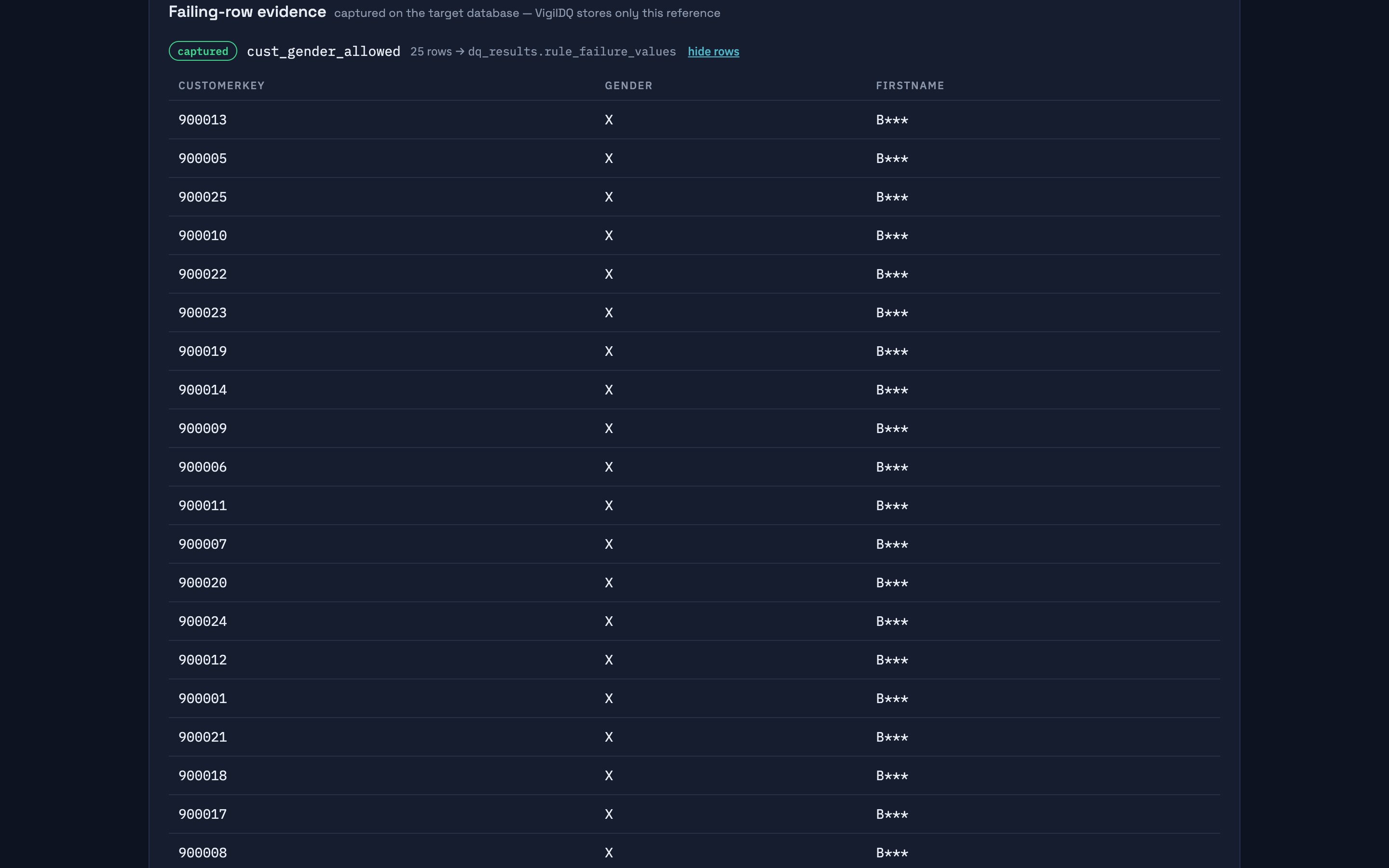
Failing rows are captured into a DQ schema in your own warehouse — capped, fail-soft, masked on display. The auditor's favourite question, pre-answered.
Every screenshot is the live product — not a mock-up.

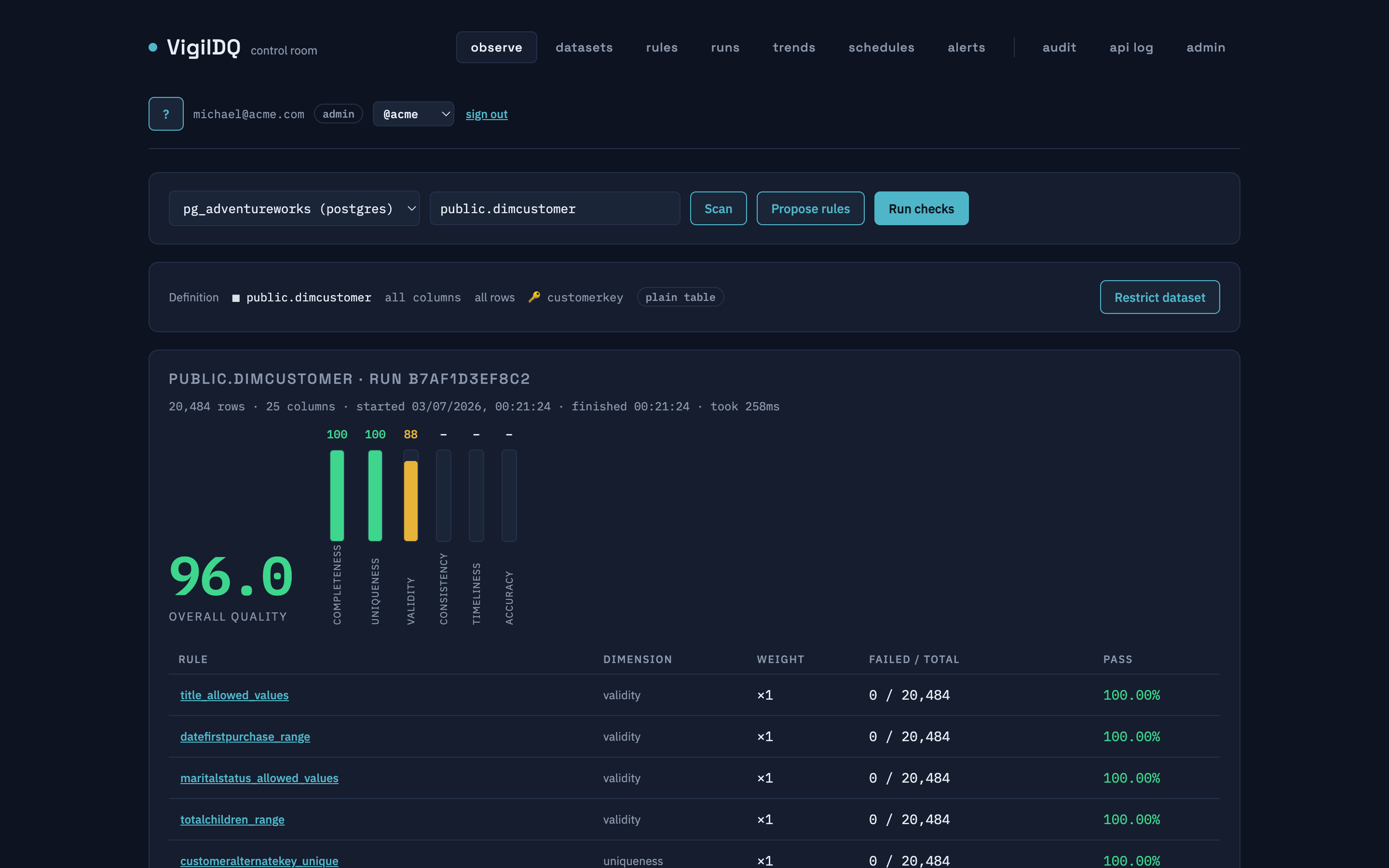
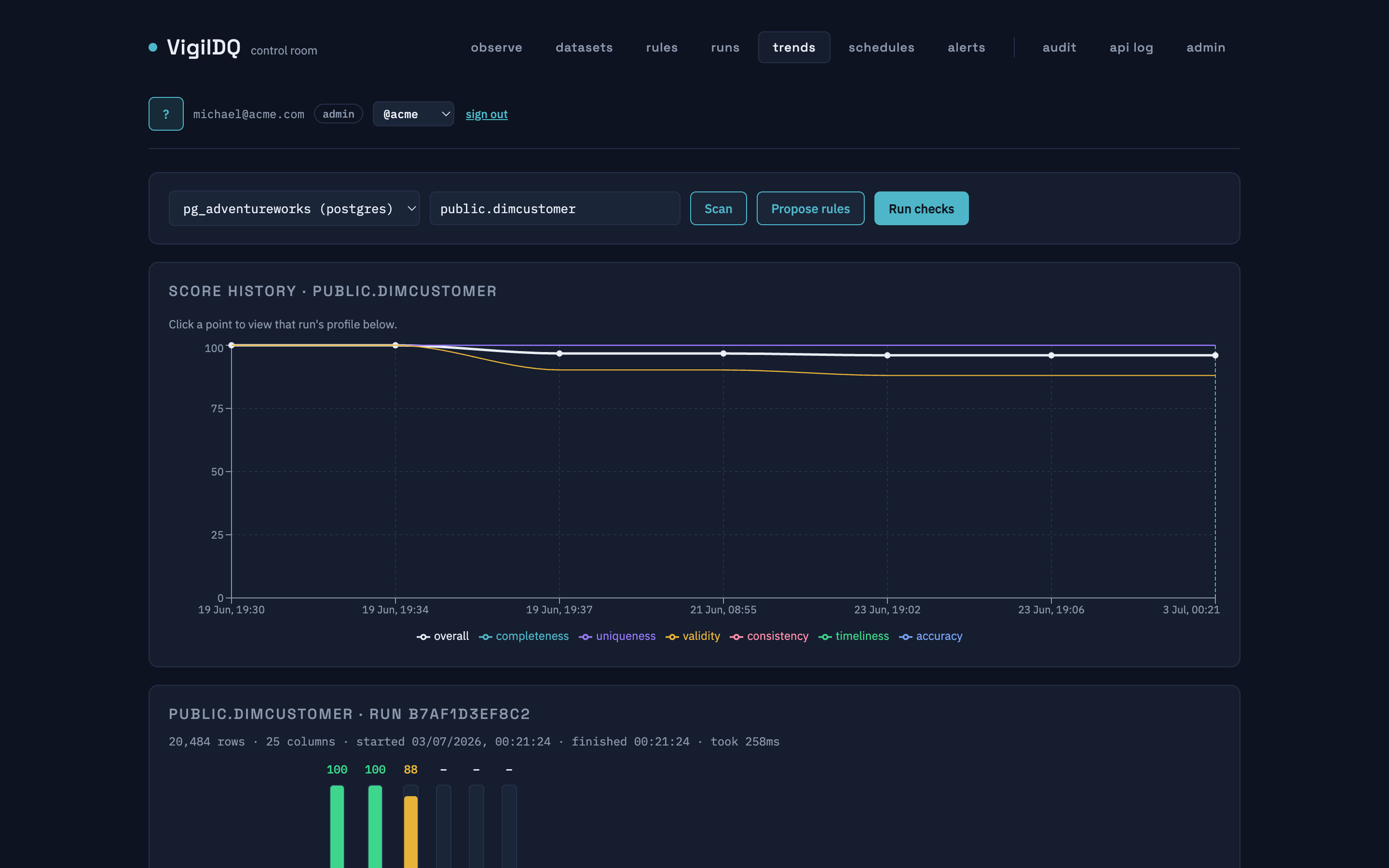
One 0–100 score across completeness, uniqueness, validity, consistency, timeliness and accuracy — decomposable to the exact rule and the exact failed count. A rule that errors scores zero, loudly. Nothing is silently skipped.

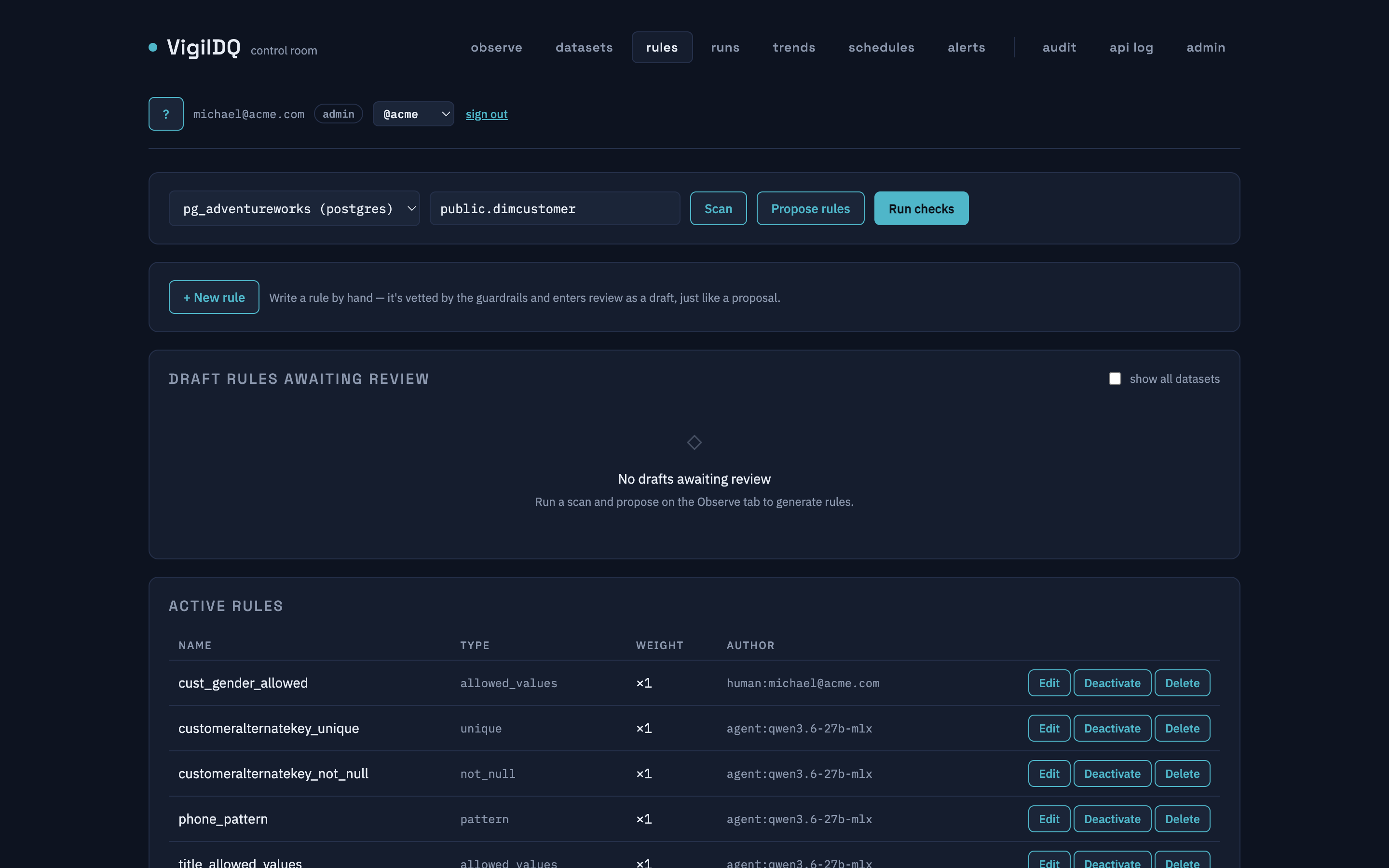
AI proposals arrive as drafts, each with a rationale grounded in your data's profile. Approve, edit or reject — and the platform records the named human behind every activation.

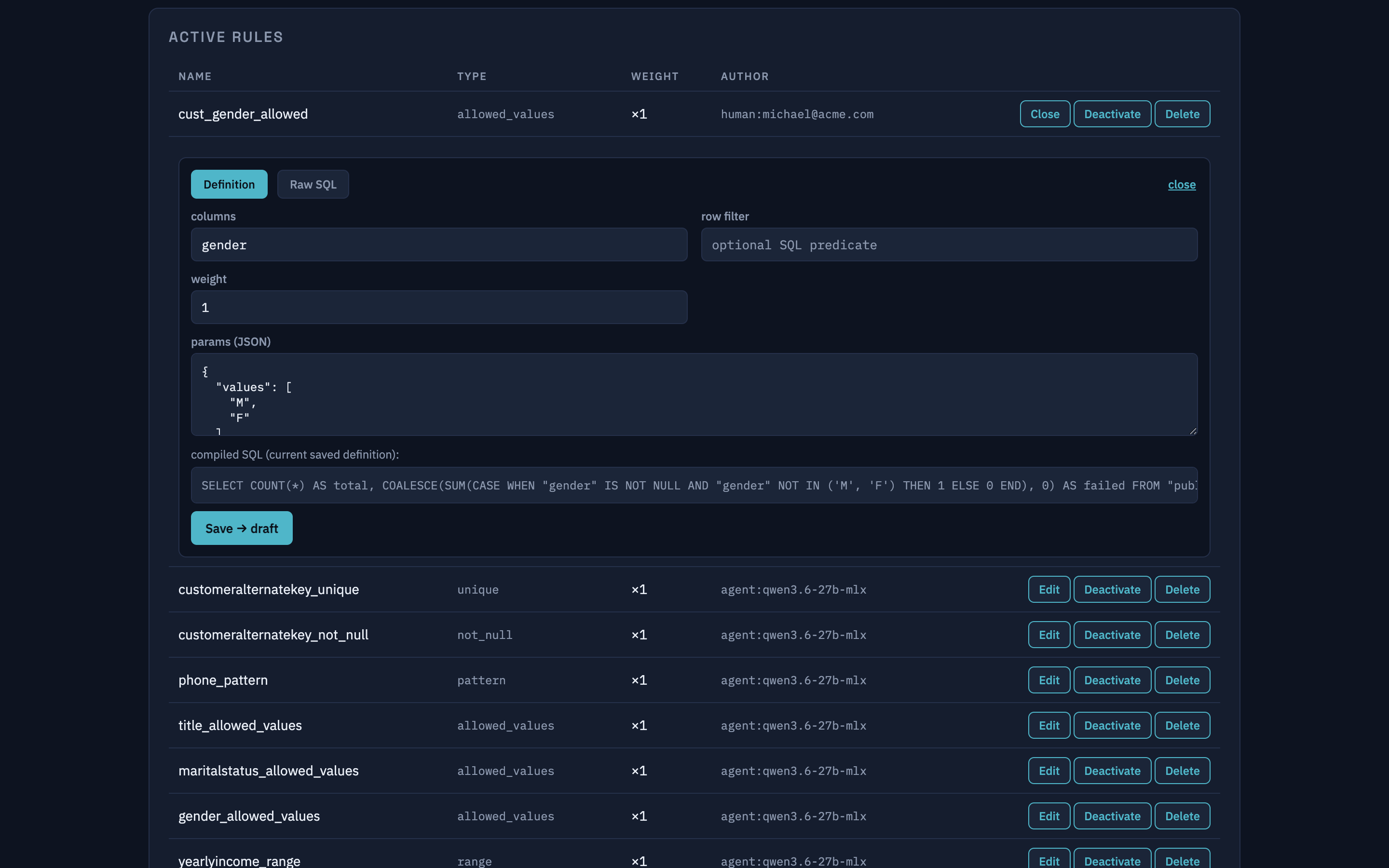
View the compiled SQL for any rule, per engine dialect. Edit the definition — or override with raw SQL for edge cases. Any logic change is re-vetted by the guardrails and reset to draft for re-approval.

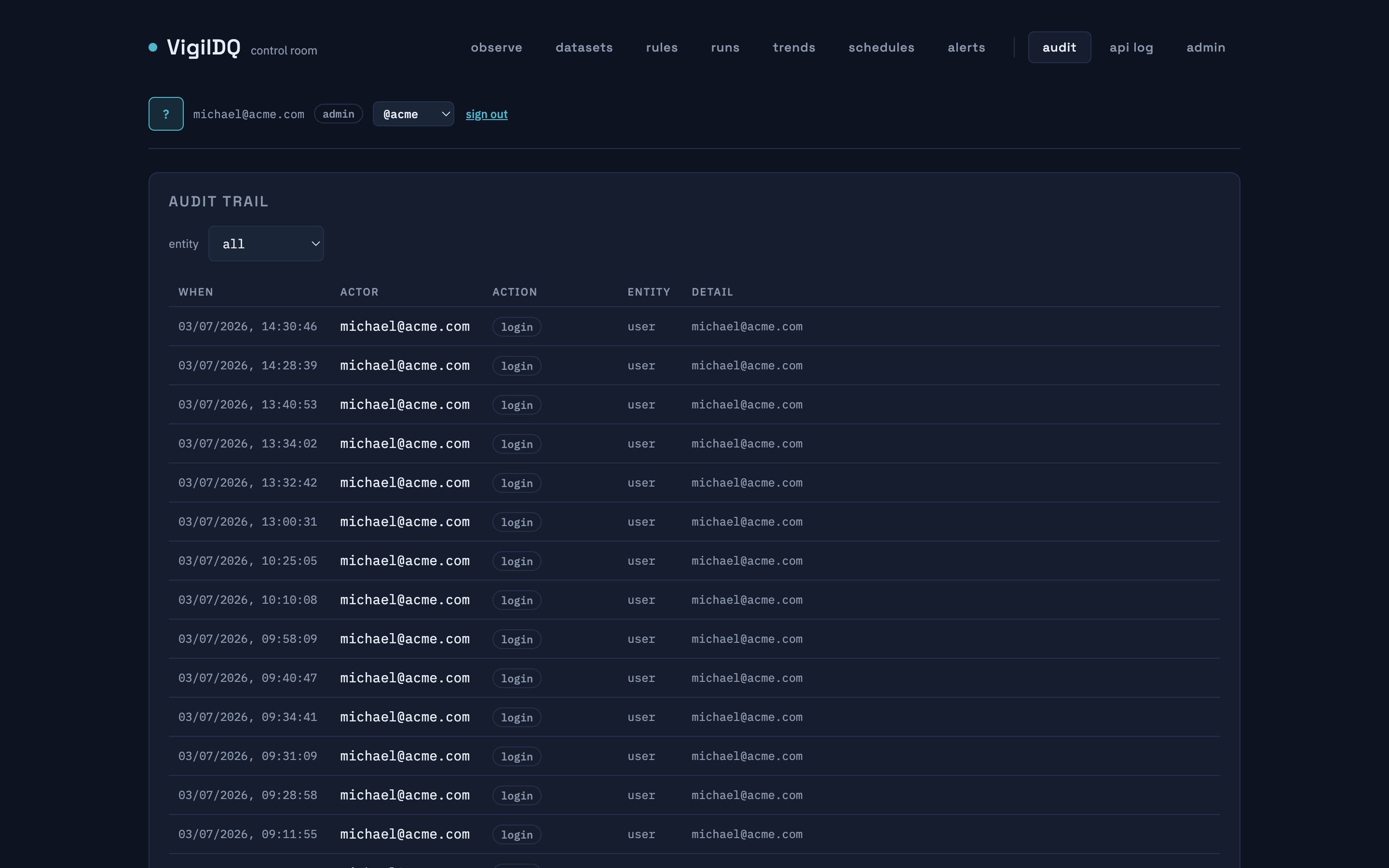
Logins, approvals, edits, configuration changes — every mutating action is appended with before/after snapshots and its actor. Append-only at the service boundary; a failed audit write never breaks the request.

Every load is scored and recorded. Drift rules — row count, null ratio, schema — judge each run against a median baseline; score alerts email your team and webhooks feed your pipeline when quality slips.
Trust is the product. This is the section your security team will read first — so it goes first in the conversation too.
Profiling and rule execution are pushed down into your warehouse as read-only SQL. What VigilDQ stores: scores, rule definitions, masked profile metadata. What it never stores: your rows.
Written to a DQ schema in your own warehouse by a separate, schema-scoped writer grant — never to VigilDQ's store, never to a vendor cloud.
A masked profile only. Boundary masking has no unmasked code path, and a test captures the AI's actual prompt to prove zero raw values reach it.
Connection credentials Fernet-encrypted at rest; API keys stored only as hashes; JWT sessions with hourly expiry; roles per tenant (admin / reviewer / viewer).
Your VM, your VPC, or fully air-gapped — with a local OpenAI-compatible LLM, nothing leaves your network at all. No SaaS dependency in the architecture.
SSO/OIDC and Postgres row-level security are in active development; SOC 2 groundwork is part of the current plan. Ask us — we'd rather you knew.

Failing rows, captured in your database, PII masked on display — those B*** names are the masking at work. This single screen answers the question that stalls most AI-tooling procurements.
The standard entry: fixed fee, fixed scope, success criteria agreed up front — typically two datasets, six weeks, your environment or ours.
Source-code licensing and escrow available — the regulated-industry answer to vendor-risk and continuity questions.
Warehouse-native architecture with one dialect seam per engine — extensions and integrations land cleanly, by us or by your team.
Catalog vendors, consultancies and platform teams: talk to us about embedding guardrailed AI data quality in your offering.
Thirty minutes on our demo warehouse: the agent proposes rules against a real schema, a guardrail refuses a bad rule, and a quality gate stops a bad load. Nothing to install, no access to your systems needed.
Book a 30-minute demo Get the technical review packPrefer email? [email protected]